Loading...
Serving Livermore, CA and surrounding areas. (925) 409-3183
Livermore Epoxy Flooring & Concrete Polishing serves Tracy homeowners with pool deck coatings, garage floor coatings, concrete sealing, and concrete resurfacing - designed around the clay-heavy soils, triple-digit summer temperatures, and 1990s-2000s tract home construction that define Tracy. Responding within one business day, serving Tracy since 2016.
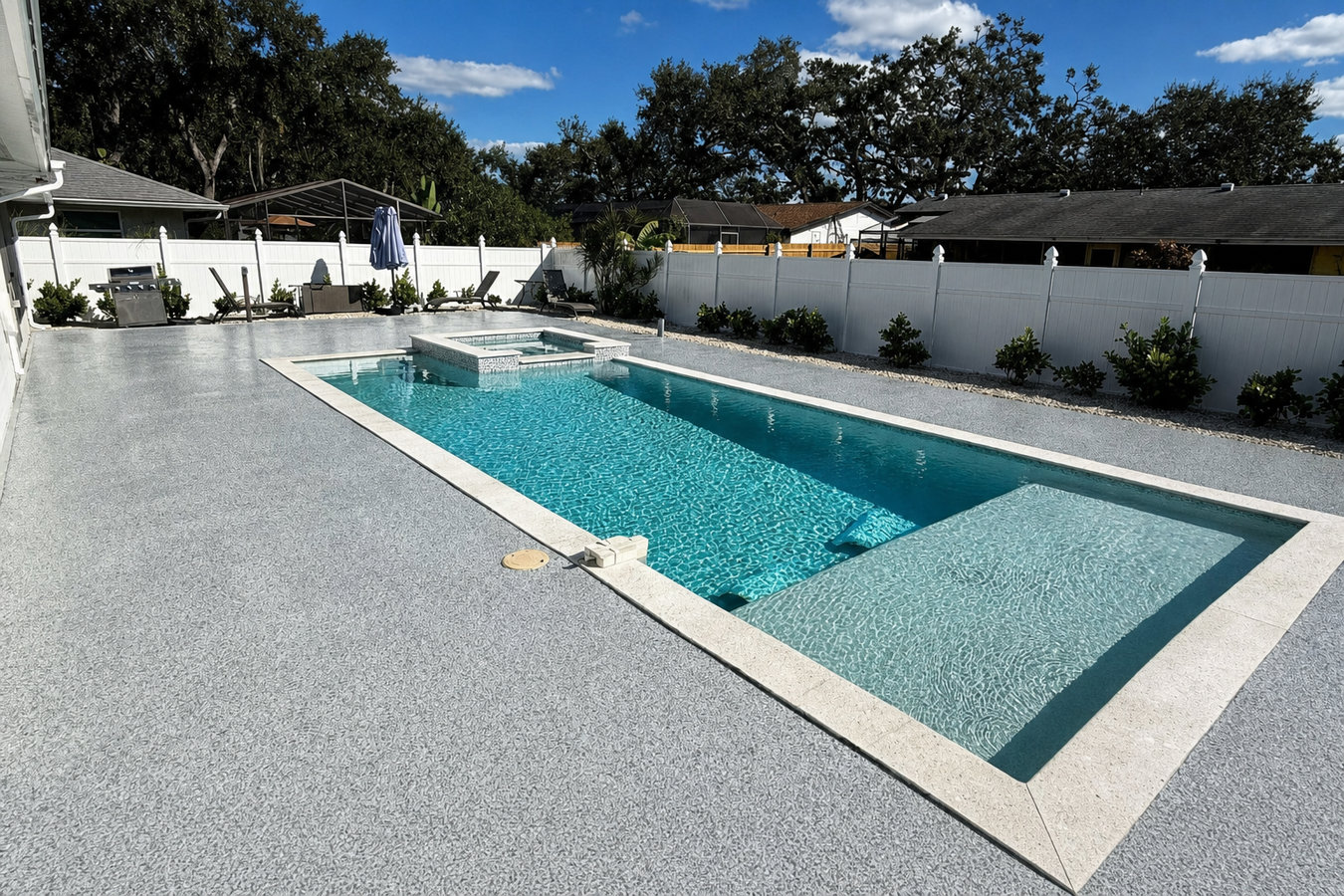
Tracy backyards see some of the most intense summer sun in the Bay Area region, and bare concrete pool decks absorb that heat until they are too hot to walk on. Our pool deck coatings and resurfacing service applies UV-stable, slip-resistant finishes that keep the surface cooler, seal out chlorine damage, and restore the look of decks that have cracked from clay soil movement beneath.
Tracy tract homes built in the 1990s and 2000s nearly all have attached two-car garages with bare concrete slabs that are now 20 to 35 years old. Those slabs have absorbed oil, salts, and moisture over the years and are ready for a chip broadcast or solid-color epoxy system that seals the surface, covers staining, and holds up to vehicle traffic in Tracy's warm, dusty conditions.
Tracy driveways and patios face a punishing cycle of dry summer heat and winter rain that draws moisture into any open concrete pore. Penetrating sealers applied every three to five years block water entry from inside the slab, which reduces the clay-soil expansion stress that causes the cracking and spalling common in Tracy neighborhoods built during the 1990s boom.
Many Tracy driveways and patio slabs from the 1990s-2000s construction era are cracked and discolored but still structurally sound beneath the surface. Where the base slab is solid, a bonded overlay repairs surface damage at a fraction of full replacement cost and delivers a fresh, sealed finish ready for Tracy summers.
Tracy homeowners converting garages to workshops, home gyms, or finished utility spaces benefit from a multi-coat epoxy system that is chemical-resistant, moisture-sealed, and easy to clean. The coating bonds directly to the concrete slab and handles the humidity swings that come with Tracy's summer heat and winter moisture cycles.
Some Tracy homeowners are pulling up carpet and tile in older parts of their homes and finding concrete slabs that are ready to polish. Polished concrete stays stable and does not warp or expand in Tracy's dry summer heat the way laminate and vinyl can, making it a low-maintenance interior flooring choice for Central Valley homes.
Tracy grew rapidly from a small agricultural town into a city of nearly 100,000 people between 1990 and 2010. The vast majority of homes built during that period are standard California tract construction - stucco exteriors, concrete slab foundations, attached garages, and concrete driveways and backyard patios. Those slabs are now 15 to 35 years old, which is the typical age when original concrete surfaces start showing the accumulated effects of seasonal stress: shrinkage cracks from summer drying, surface pop-outs from winter moisture, and oil saturation in garage floors that bare concrete cannot prevent. A contractor unfamiliar with tract-era construction in the Central Valley may not recognize the specific prep issues - carbonated surfaces, contaminated slabs - that need to be addressed before any coating will bond correctly.
Tracy sits in San Joaquin County on clay-heavy soils that swell in the wet season and shrink dramatically in the dry summer heat - temperatures that regularly hit 95 to 100 degrees Fahrenheit and sometimes higher. That soil movement works against concrete from below, and the surface stress from UV radiation and thermal cycling works from above. Pool decks face the additional challenge of chlorine exposure and water splashing on top of the clay-soil and heat cycle. The result is that Tracy driveways, pool decks, and patios age faster than the same surfaces in coastal cities, and they need materials and application methods chosen for Central Valley conditions, not just Bay Area averages.
Our crew works in Tracy regularly, serving homeowners across the planned subdivisions that make up most of the city. Tracy's residential areas are built along a grid of major roads - Grant Line Road, Cordes Road, MacArthur Drive, and the streets feeding off I-205 - and each cluster of neighborhoods tends to share the same construction vintage and the same concrete issues that come with it. When we pull up to a home in Tracy Hills or the neighborhoods near West Valley Mall, we already have a good idea of what the slab looks like underneath and what preparation it will need.
Older parts of Tracy near downtown and the railroad corridor date to the early and mid-1900s. Those homes have different foundation types and original concrete that behaves differently than the modern tract slabs across the rest of the city. For permit questions on any Tracy project, the City of Tracy Community Development Department handles building review for both residential and commercial work. We also serve homeowners in Livermore, where clay-soil and heat conditions run parallel to Tracy but the housing stock skews older.
We also regularly work in Concord, another inland city where postwar ranch homes and clay soil create concrete challenges similar to what Tracy homeowners face. Scheduling for Tracy jobs is straightforward - we respond within one business day and can typically get a crew on-site within the week.
Reach us by phone or through the estimate form and describe your project - pool deck, garage, driveway, or interior floor. We respond to all Tracy inquiries within one business day and ask a few questions upfront to understand the scope before scheduling a visit.
We come to your Tracy property to measure the area, check the slab condition, and test for moisture - all at no charge. You receive a written quote that breaks out prep, materials, and labor so you know exactly what you are paying for and why before any work begins.
Most Tracy jobs begin with mechanical grinding or shot blasting to open the concrete profile and remove contamination. The coating or overlay is then applied in controlled conditions - we schedule around Tracy's summer heat to avoid applying coatings during peak afternoon temperatures that affect cure times and adhesion.
When the work is complete, we walk the finished surface with you, explain cure times and any access restrictions, and go over care instructions. Pool deck coatings typically need 24 hours before foot traffic and 72 hours before pool use can resume.
We serve Tracy homeowners from Tracy Hills to the older neighborhoods near downtown. Free estimates, no obligation, and a response within one business day.
(925) 409-3183Tracy is a city of nearly 100,000 people at the intersection of I-205 and I-580 in San Joaquin County, about 60 miles east of San Francisco. The city grew dramatically between 1990 and 2010 as Bay Area workers moved east seeking more affordable housing. That growth built out planned subdivisions across most of the city, from Tracy Hills on the western edge to the streets off Cordes Road and MacArthur Drive further east. Most homes are single-family detached houses on lots of 5,000 to 8,000 square feet with attached garages, concrete driveways, and backyard patios - the same layout repeated across dozens of neighborhoods. Tracy also has an older downtown district near the historic railroad corridor with homes dating to the early 1900s that present a different set of construction conditions.
Tracy has a strong identity as a working city. Many residents commute to the Bay Area, and the city is also a major distribution and logistics hub with large warehouse facilities near the freeway interchanges. The annual Tracy Dry Bean Festival draws residents from across the region each September, reflecting the city's agricultural roots in the Central Valley. Homeowners throughout Tracy - from longtime residents in the older neighborhoods to newer arrivals in the planned subdivisions - share a common interest in maintaining their property values in a city where the housing market has grown significantly. We also serve nearby Antioch, which shares Tracy's mix of newer tract developments and older established neighborhoods with similar concrete maintenance needs.
Durable, high-gloss epoxy coatings that protect and beautify any concrete floor.
Learn MoreHeavy-duty epoxy systems built for warehouses, factories, and commercial spaces.
Learn MoreFast-curing polyaspartic coatings that resist scratches, UV, and chemicals.
Learn MoreStunning metallic finishes that turn ordinary floors into works of art.
Learn MoreChemical- and thermal-resistant floors ideal for food production and labs.
Learn MoreSmooth, reflective polished concrete that is low-maintenance and long-lasting.
Learn MoreRich color stains that give concrete a unique, decorative appearance.
Learn MoreClassic terrazzo installations combining beauty and exceptional durability.
Learn MoreMoisture-resistant basement floor systems designed for comfort and durability.
Learn MoreProfessional surface preparation ensuring coatings bond and last longer.
Learn MorePenetrating and topical sealers that protect concrete from stains and wear.
Learn MoreOverlay systems that restore worn or damaged concrete to like-new condition.
Learn MoreSelf-leveling overlays that create a perfectly flat, smooth floor surface.
Learn MoreSlip-resistant, UV-stable coatings that refresh and protect pool decks.
Learn MoreSafe removal of old coatings and adhesives to prepare floors for new finishes.
Learn MoreGet a free estimate on pool deck coatings, garage floor coatings, or any concrete project. We respond within one business day - call now or submit the form.